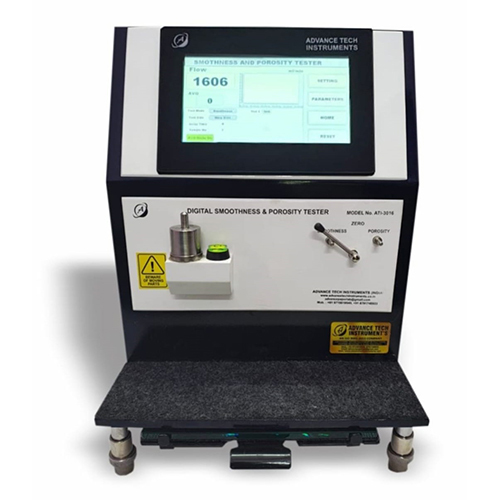
About Digital Smoothness And Porosity Tester
|
Stiffness unit
|
Sample size
|
weight
|
|
|
0 - 1
|
1.5" x 1.5
|
10 Unit Compensator
|
15 Deg
|
|
0 - 10
|
1.5" x 1.5
|
10 Unit Compensator
|
15 Deg
|
|
10 - 100
|
1.5" x 2.75"
|
|
15 Deg
|
|
50 - 500
|
1.5" x 2.75"
|
500 Unit
|
15 Deg
|
|
100 - 1000
|
1.5" x 2.75"
|
1000 Unit
|
15 Deg
|
|
200 - 2000
|
1.5" x 2.75"
|
2000 Unit
|
15 Deg
|
|
300 - 3000
|
1.5" x 2.75"
|
3000 Unit
|
15 Deg
|
|
500 - 5000
|
1.5" x 2.75"
|
5000 Unit
|
15 Deg
|
|
1000 - 10000
|
1.5" x 2.75"
|
5000 Unit
|
7 1/2 Deg
|
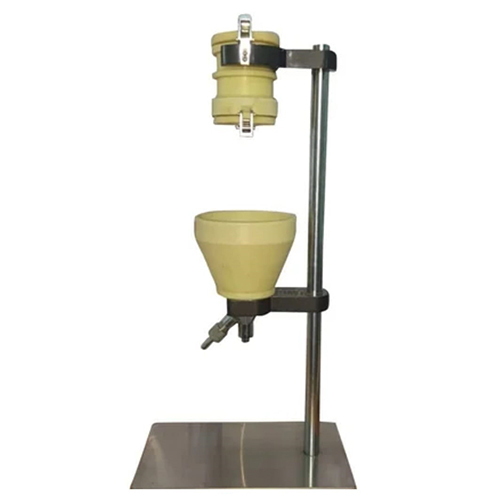
Advanced Testing CapabilitiesEquipped with a pneumatic clamping mechanism and functioning on the Gurley principle, the tester delivers consistent, accurate assessments of material smoothness and porosity. With a measuring range of 10 to 600 ml/min and a resolution of 0.1 ml/min, it is suitable for quality control in demanding industrial environments.
User-Friendly Interface and Data ManagementThe digital panel allows operators to control the semi-automatic machine easily. Test data can be quickly stored (up to 99 results) and transferred via USB. Its memory function streamlines batch testing, and the auto/manual calibration ensures reliable operation.
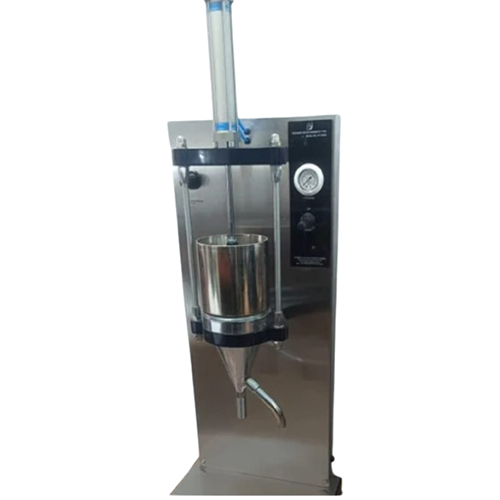
Durability and Safety AssuredConstructed from stainless steel, the tester is both robust and reliable. It incorporates overload protection for operational safety and operates at a low ambient noise level (<60 dB), ensuring a comfortable workplace. Its compact, tabletop design fits seamlessly into most labs or production facilities.
FAQs of Digital Smoothness And Porosity Tester:
Q: How does the Digital Smoothness and Porosity Tester operate?
A: The tester uses the Gurley method, where filtered air is passed through a specimen clamped pneumatically. It measures the time taken for a specific air volume to pass through, providing digital smoothness and porosity readings with high precision.
Q: What types of materials can this equipment test?
A: This instrument is designed for evaluating the smoothness and porosity of paper, cardboard, and board specimens measuring 100 100 mm.
Q: When should I use automatic versus manual calibration?
A: Automatic calibration is ideal for routine checks or frequent use to ensure consistent results, while manual calibration provides more control when testing new material types or verifying instrument accuracy after maintenance.
Q: Where can test data be stored and accessed?
A: Test data can be saved on the devices internal memory, accommodating up to 99 results, and can be exported easily through the integrated USB interface for further analysis or record-keeping.
Q: What is the process for conducting a test?
A: To perform a test, position the specimen in the sample holder, initiate the pneumatic clamp, and start the test via the digital control panel. The device automatically times and records the airflow through the sample, displaying results digitally.
Q: How does the device enhance safety during operation?
A: The tester features overload protection to prevent equipment damage and ensure user safety during operation. It also operates below 60 dB, reducing noise-related distractions in the workspace.
Q: What are the benefits of using this tester for industrial applications?
A: This tester provides quick, precise, and repeatable measurements. Its user-friendly digital interface, robust construction, and support for both data storage and USB export make it an efficient solution for quality control in paper and board production environments.



 Send Inquiry

 Send Inquiry